


What kind of wedding rings did newlyweds wear during the Warsaw Rising? Obviously, there was no chance of buying them at a jeweller’s. Yet, in August and September 1944 about 50 couples got married.
There may have been more but there is no evidence for that. Today we are reminded of these love stories by memorabilia from over 80 years ago, such as the six priceless wedding bands treasured in the Warsaw Rising Museum Collection.
Bolesław Biega „Pałąk" described his wedding day, 13 August 1944, as very happy.
At first the groom's father was opposed to the idea, (...) however, his son explained that he and his fiancée, Alicja Treutler „Jarmuż”, have known and loved each other for several years and all pre-war social conventions did not matter anymore since they might die the very next day.
It was one of the first weddings during the Rising. As the ceremony was immortalized on tape, the newlyweds became well-known. Footage of the Biegas' wedding was played in Palladium cinema two days after the ceremony. A field altar was set up in a store at 11 Moniuszki street on stacks of paper.
The groom's borrowed uniform jacket was pulled with difficulty onto his shoulder, since at the time it was in in a cast. The bride came accompanied by six bridesmaids and was carrying a bouquet of white gladioli. Due to a German attack against the positions held by the Kiliński Batallion, in which Bolesław served, none of his closest friends could attend the ceremony. Instead, filmmakers from the Film Section of the Bureau of Information and Propaganda of the Home Army Headquarters, which was based nearby in ‘Adria’ club showed up. Thanks to this, the entire wedding ceremony was recorded on tape and photographed, despite the discontent of the battalion chaplain, Father Wiktor Potrzebski “Corda.” During the ceremony they the newlyweds exchanged rings - brass curtain rings.
The newlyweds, wedding guests (the patients at the hospital where Bolesław was staying prior to the wedding) and friends who were able to attend the ceremony, were invited to the ‘wedding party’, where canned sardines, French pâté, and sponge cakes were served. These were the delicacies that had been taken from the Germans during the recapture of the Main Post Office building. The toast was made with vodka.
Another reception was held in the company's headquarters at the Main Post Office (Napoleon Square, now Warsaw Insurgents Square). Due to the shelling, the newlyweds had to make their way back running along the barricade.
Photos from the Biegas’ wedding were also published in the insurgent press and, after the war, in books about the Warsaw Rising. Fragments of the footage were shown on American television in 1976, in a documentary about what happened in Warsaw in 1944.
The day of the wedding the bride was 20 years old, and her groom was two years older than her.
Alicja and Bolesław Biega were married for 75 years until Alicja's death on 20 September 2019 (she was 96 years old). Bolesław died on 18 May 2023 at the age of 100.
During the Warsaw Rising mostly young people got married. Soldiers would marry medics or liaison girls, who usually served in the same unit. It is said that during the 63 days of the Rising up to 300 weddings were concluded, although there is no definite proof. Not all of the wedding rings lived to see today. Many were lost, others destroyed. The same happened to the documents and certificates.
These estimates are highly optimistic - the figure of 300 weddings is questionable. The first wedding in the City Centre (Śródmieście district) took place on 12 August 1944, so to reach the number 300 about 6 weddings a day must have been held until the end of the Rising, which is very unlikely. According to Marcelina Koprowska’s research, the largest number of ceremonies - a dozen or so - took place at the All Saints Parish in Śródmieście on Grzybowski Square (the last one on 27 September 1944). In the Old Town, only a few ceremonies were recorded until 30 August 1944.
Similarly in Żoliborz through 6 September 1944.
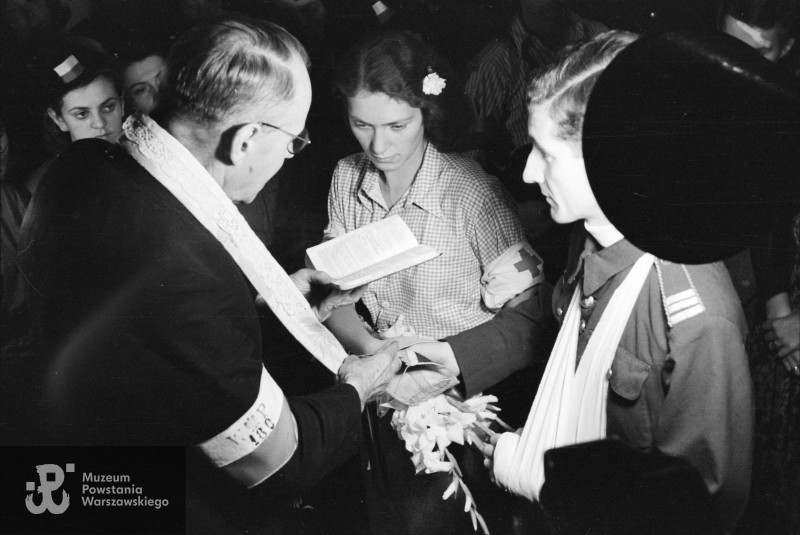
Wedding of a medic Alicja Treutler "Jarmuż" and platoon cadet Bolesław Biega "Pałąka" in a chapel on 11 Moniuszki street. Ceremony conducted by Father capitan Wiktor Potrzebski „Corda” on August 13th 1944. Photo by Eugeniusz Lokajski „Brok” (The Warsaw Rising Museum Collection).
In the book „Służba duszpasterska Armii Krajowej w Powstaniu Warszawskim” („Pastoral Ministry of the Home Army in the Warsaw Rising” published in 1996) edited by Prof. Piotr Matusak, we read that several dozen couples got married during the Warsaw Rising. Maria Krawczyk, who has researched this topic, wrote in 2001 that “weddings during the Rising never became widespread.” In 2006, in a special issue of the magazine Mówią Wieki, Ewa Zientara published the results of her research conducted in parish records, which indicated that over 50 couples were married during the Rising.
Additionally, in an unpublished study from 2012, Ewa Berbecka documented only 48 weddings based on records from Warsaw parishes. In her 2022 publication on religious life, Marcelina Koprowska presented data on 52 ceremonies, but she included several weddings from August 1 - which were most likely held before “W” Hour - as ceremonies taking place in the first days of the Rising are highly unlikely.
What is remarkable about these weddings is not only the number, but the phenomenon itself - young people who wanted to get married despite the battle raging in the city.
Colonel Antoni Chruściel “Monter,” Commander of the Warsaw District of the Home Army (AK), set forth procedures for the marriages of Polish soldiers in an order dated 18 August 1944 (No. 19, Section 4/IV). Those getting married were required to submit detailed personal information to the Home Army (AK) District Command: personal details, residential addresses prior to the Warsaw Rising, and current military assignments. They were also required to provide the chaplain’s name and the unit to which he was assigned. The Museum of Warsaw Rising's collection includes four handwritten marriage certificates documenting wedding ceremonies.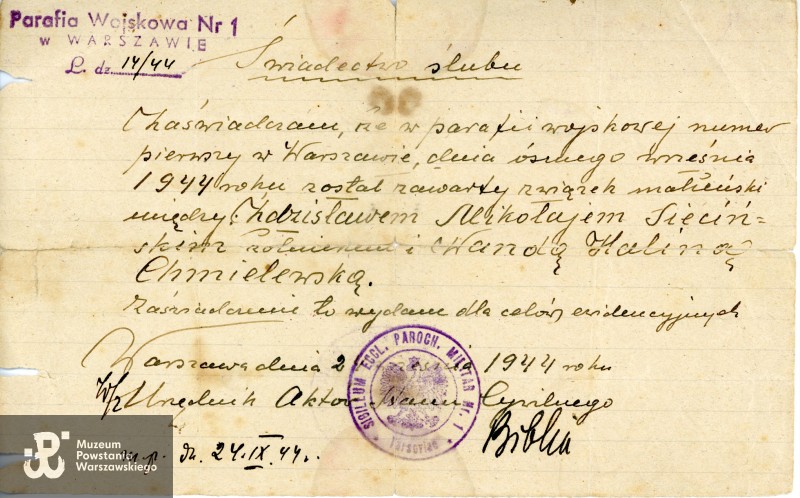
Shown above is the certificate of Wanda Chmielewska and Mikołaj Sieciński, who were married on 8 September 1944. The document was signed on 24 September by the chief chaplain of the Home Army (AK), Father colonel Stefan Kowalczyk “Biblia.”
It was not only the Biegas who had unusual wedding rings. The wedding jewelry worn by insurgents was often not made of precious metals, even though it was purchased at a high price (or sometimes gifted). In some cases, wedding rings were made from various military items, such as bullet casings or bearings. People used whatever was at hand, like grommets for curtains and drapes. Sometimes each wedding band was made from different material. Often, a single band - worn by the bride - was enough, and there were even cases of weddings without any wedding bands.
The steel wedding rings of Cecylia Tomira Pakowska “Mirka” and second lieutenant Stanisław Swinarski “Sułtan” were made from bullet casings at the gunsmith’s shop at 12 Poznańska Street. Apart from the rings, the Museum also holds the couple’s marriage certificate, issued on 3 October 1944, and signed by the insurgent chaplain, Father Mieczysław Mielecki, “Mietek”.
The wedding ring of Grażyna Gilewicz “Grażyna,” a messenger of the 2nd Information and Intelligence Division of the Home Army (AK) Headquarters, who married another member of her unit, lieutenant Maciej Brochocki “Luśniak,” on 23 September 1944, is made of silver and uniquely decorated. The ceremony was conducted by Father Stefan Piotrowski, “Jan I”. A wedding ring was bought for Grażyna. Maciej didn’t have one of his own. The ceremony took place in the chapel on Wilcza Street. The bride wore a suede jacket, thin stockings and held a geranium in her hand. Afterward, there was a reception, and the menu included: “dark-flour drop noodles and canned spinach,” alongside alcohol.
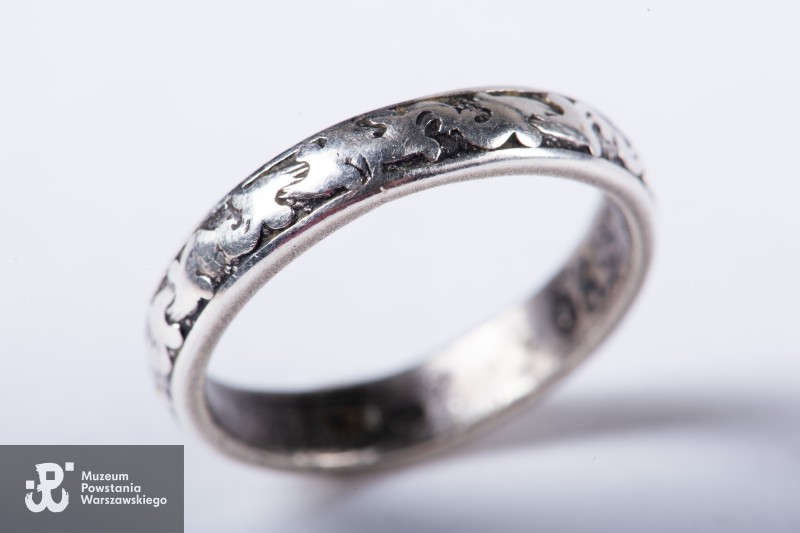
Wedding ring of Grażyna Brochocka “Grażyna,” (The Warsaw Rising Museum Collection).
Barbara Brudek “Głowacka,” “Iza,” a messenger for the “Chrobry II” Group, was not yet 18 years old when she decided to get married. As a minor she had to obtain permission from the Home Army (AK) command first. Her fiancé was Jan Rytel “Iza.” The military authorities had no objections, so the couple turned to the Dominican priest Father Michał Czartoryski OP, known as “Father Michał”, who officiated the ceremony on 27 August 1944, at a church on Tamka Street.
The young couple will always remember the guard of honor formed by their comrades from the 3rd Company of the “Konrad” unit of the “Krybar” combat group, standing with their rifles crossed, through which the couple walked to the altar. What followed were wishes from loved ones as well as strangers, and a gift of 5 kg of horse meat, which, after being prepared with potatoes, crowned the wedding reception. The meal was accompanied by the sound of the piano.
The Rytels metal rings were not identical. The bride received hers from an unknown woman, while the groom bought a larger one for a hefty price from a stranger. Although they were not made of precious metal - as “Iza” recalled years later - they were one of their most precious keepsakes.
Maria Nowotna “Róża” and Jan Walc “Jasio,” who were the first couple to marry during the Rising on 12 August 1944, wore wedding rings made from a machine gun bearing. They continued to wear their wedding rings even after the war—until the skin on their fingers began to turn green. Their relationship remained strong even after they replaced their wedding rings. They spent their entire lives together.
The famous Warsaw courier, lieutenant Zdzisław Jeziorański “Nowak”, and his fiancée, Jadwiga Wolska “Greta”, exchanged watches during their wedding on 7 September 1944.
He gave her an Omega, and she gave him a small watch that had belonged to her sister, Barbara Wolska “Jula”, who had been killed three weeks earlier.
Maria Huber “Marianna” and senior cadet Kazimierz Piechotka “Jacek”, who were married in early September 1944, did not have any wedding rings.
Danuta Gnass “Danka,” a medic from the “Zaremba-Piorun” battalion, married Zbigniew Piotrowski on 29 August 1944, using her father-in-law’s wedding ring, which had been resized to fit her finger. After the war, she could no longer remember what her husband wore on his finger.
Danuta Koziej “Magda” (later Wrzosińska), a messenger in the Warsaw’s sewers, attended a friend’s wedding during the Warsaw Rising - the newlyweds had made their wedding rings from “some metal plates.”
Zofia Mac (later Szczepańska) “Zosia” of the “Granat” Artillery Group, who got married on 20 August 1944, gave little thought to the wedding rings: “My husband bought some - they were bronze, but they were there.”
Private Janusz Skowroński “Wrona”, of the Home Army’s (AK) “Baszta” regiment, had a wedding ring made of tombac (an alloy containing more than 80 percent copper and zinc).
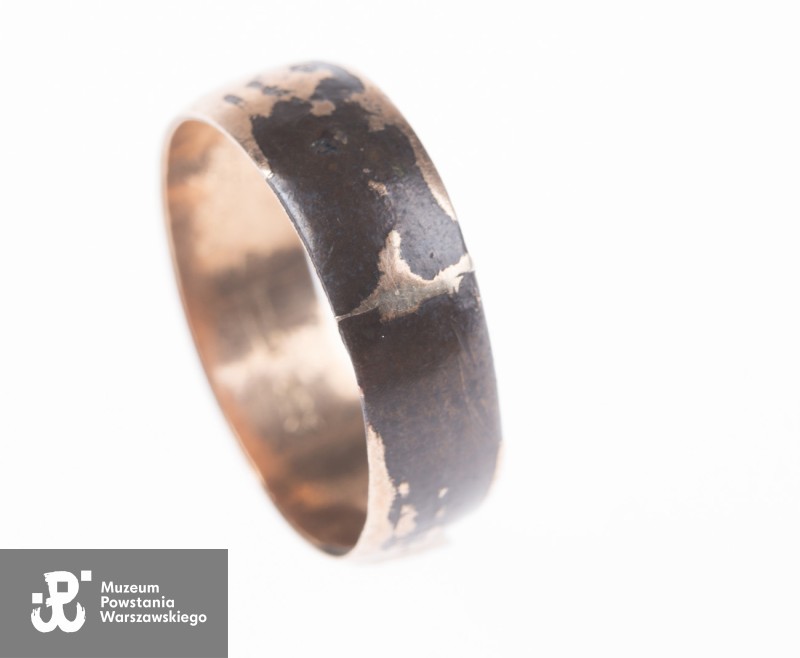
Janusz Skowroński “Wrona”’s wedding ring, (The Warsaw Rising Museum Collection)
***
The preserved wedding rings from the time of the Warsaw Rising encapsulate stories of great love, but also of determination, resourcefulness, youthful excitement, uncertainty, defiance, the need to escape reality, the will to live, faith and hope.
Dr. Michał Tomasz Wójciuk - Historian, archivist, museum curator. Researcher in the History Department of the Warsaw Rising Museum. Author of over 30 academic publications and nearly 100 popular science works.
Co-author of research and texts used in the permanent exhibitions of the Warsaw Rising Museum and the Dulag 121 Museum in Pruszków, as well as in over a dozen temporary exhibitions in Poland and in international exhibitions in fourteen countries across four continents. Consultant for books, comic books, and films.
Translated by Aleksandra Chrzanowska
What belongs to the collections of the Warsaw Rising Museum?
- the wedding rings of Cecylia and Stanisław Swinarski, made from bullet casings,
- the wedding ring of Grażyna Brochocka “Grażyna”,
- the wedding rings of Barbara and Jan Rytel, blessed by Father Michał Czartoryski OP “Father Michał", on August 27th 1944,
- the wedding ring of Janusz Skowroński “Wrona”,
- four handwritten marriage certificates documenting wedding ceremonies held during the Rising.
Article by Michał Tomasz Wójciuk