


Warsaw Rising insurgents celebrated Christmas in 1944 far from home - in German POW camps, concentration camps or as forced laborers in the Third Reich. Facing adverse circumstances, they tried to find some rays of hope…
Photographs, as well as preserved items and testimonies of those who survived WW2 provide us with the account of what Christmas 1944 looked like.
Wiesław Chrzanowski ‘Wiesław’ is the author of photos taken in the barracks no.198 in Oflag XI B/Z Bergen-Belsen. One of these photographs shows a Christmas time scene and the Warsaw Rising soldiers who belonged to the ‘Gustaw’ Battalion. One can see, among others, a Christmas tree decorated with shimmering ribbons, chains, and toys in the shape of stars, little figures and animals. The Christmas atmosphere was further highlighted with Lieutenant Jan Gładych ‘Bemol’ playing the accordion. A Christmas tree is typical of Christmas holidays – in the reality of war imprisonment it was decorated with objects of everyday use and handmade toys.
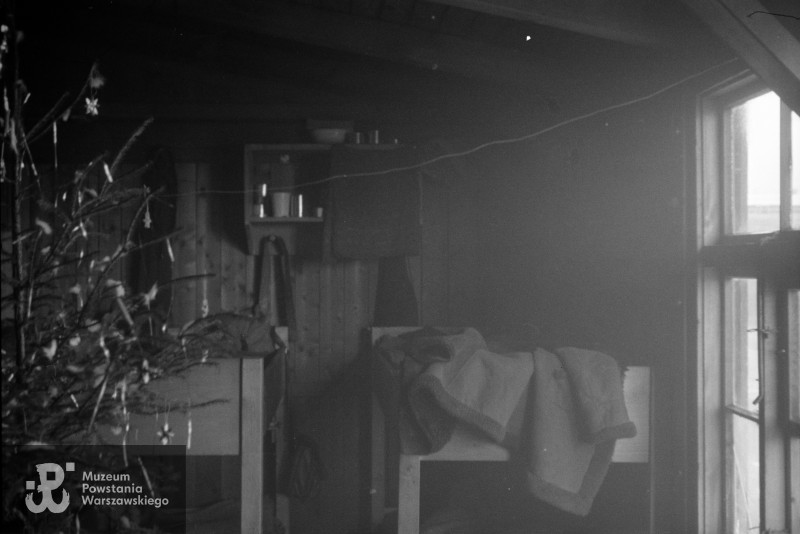
Barracks no. 198 in Oflag XI B/z Bergen Belsen. Photo by Wiesław Chrzanowski 'Wiesław'/ Warsaw Rising Museum Collection
In the collection of the Warsaw Rising Museum we have a Christmas decoration that was made in Oflag IX C Molsdorf. It is a 1.5 centimeters ornament - a puppet made from a tin can and painted red. The characteristic elements of the figure are its face, hands, buttons, and decorations on the hat; these details were painted. The puppet belonged to Lieutenant Janina Kozłowska ‘Doktor Bronka’, who, during the Warsaw Rising, worked in a field hospital located at Solec Street.
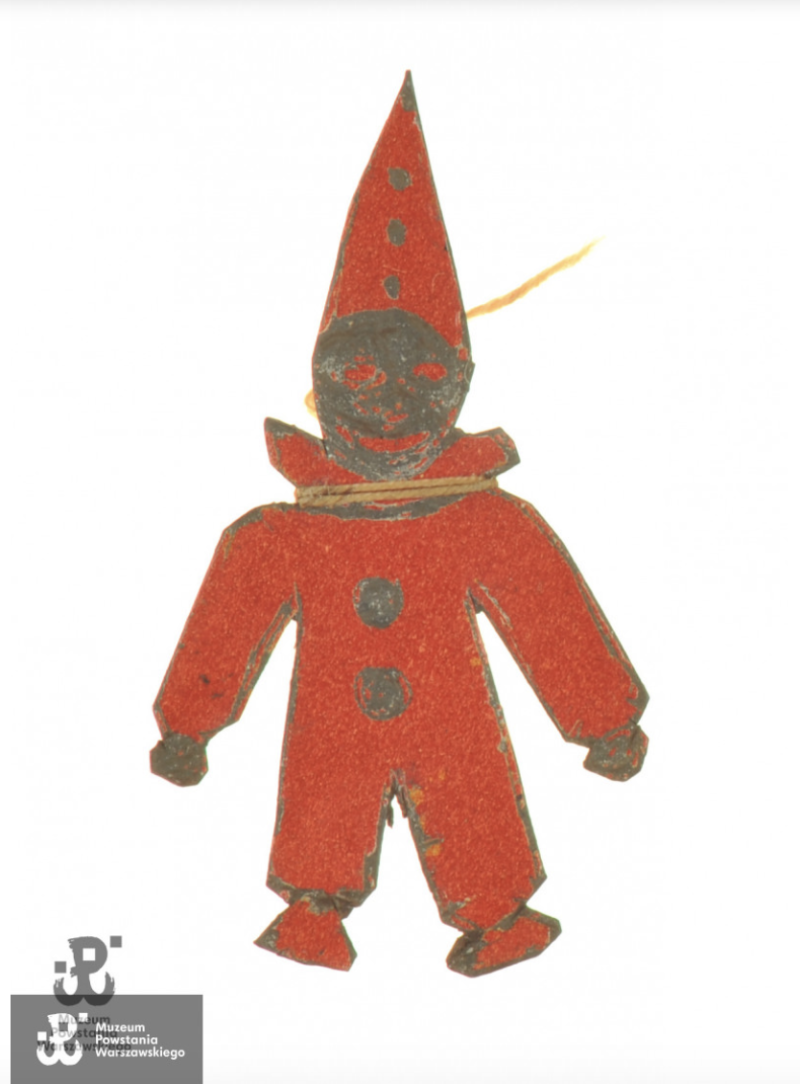
A puppet made from a tin can. A Christmas decoration made in December 1944 in Molsdorf oflag. Photo // Warsaw Rising Museum Collection
The Christmas ornaments made by the prisoners possessed a mocking character. The commander of the AK ‘Baszta’ Regiment, platoon leader Mieczysław Chorąży ‘Grom’, (later he would become a professor of oncology) recalled that caricatures of Germans from the camp staff, cut out of paper or other materials, were hung on the Christmas tree in Stalag XI A Altengrabow. The figures of these officials had exaggerated physical defects or characteristic items associated with them; for example, the “popular" guard had a prosthetic leg and a bike as part of his attributes. Sometimes the decorations took on a patriotic tone. Captain Janina Majorkiewicz-Antoniak ‘Zosia Jawor’ from the Zaremba-Piorun unit recounted that the Christmas tree in the barracks of the Molsdorf POW camp was decorated by the female prisoners with white and red "symbols" from the Rising. The decoration of the tree or the coniferous branch was made of cotton. The liaison and paramedic Krystyna Friedwald (née Chrostek) ‘Mewa’, who worked during a day in an airplane factory near Berlin, remembered that she found a large coniferous branch which she dragged along with her back to the POW camp where she was incarcerated every night. Along with her friends, they placed it in the “hole” of a toilet that was inside the barracks. The insurgent paramedics had a little bit of cotton, which they used to decorate the tree, making the illusion of snow.
A fifteen-year-old Warsaw Insurgent, Tadeusz Jarosz ‘Topacz’, was imprisoned in the camp Voerde bei Wesel, about thirty kilometers from Essen, along with a friend and peer, Witold Niewiadomski. They agreed in principle that "we could not imagine that Christmas Eve would pass without a Christmas tree." That is why, they sneaked outside the camp through a hole in the fence. Risking their lives and bringing a fantasy to life, they got through the fence and entered the forest. They returned with a little spruce in hand that would become a Christmas tree inside their barracks.

Music in the barracks. Jan Gładych 'Bemol' playing the accordion. Photo by Wiesław Chrzanowski 'Wiesław'/ Warsaw Rising Museum Collection
‘Topacz’ remembered that after his and his friends' Christmas wishes, they started to sing the ‘’Bóg się rodzi’’ Christmas carol (in English “God is being born”). From the other side of the building where the guards were staying, the Austrian Christmas carol "Stille Nacht, heilige Nacht" was heard, which ‘Topacz’ came to hate. ‘Topacz’ was not the only insurgent who had a negative connotation with this particular Christmas carol. In Stalag VI C Oberlangen, Alina Jasińska (née Matuszewska) from the ‘Bradl’ Battalion ‘’Miłosz’’ recalled: ‘’Germans placed huge Christmas trees with lights for the prisoners. They sang ‘Stille Nacht’...” In Molsdorf the Germans provided one or two coniferous trees which were to be shared for seven barracks. The prisoners broke the Christmas trees in a way so that each barrack would have their own. The liaison officer of the 1st Company of the ‘Krybar’ Battle Group, Lucyna Borkowska ‘Żaba’ (née Buraczewska), remembered how a guard came to the sad, cold, and hungry participants of the Rising in Oberlangen with a coniferous tree, ordering them to sing ‘Stille Nacht.’ Everyone ignored him.
Haunted by longing, the insurgents sometimes found it extremely difficult to sing Polish Christmas carols. Twenty-year-old shooter Jerzy Kuncewicz ‘Podhalanin’ from the ‘Pięść’ Battalion was taken to Gütersloh, located in western Germany, for forced labor. Working as a welder, he befriended Marysia at his settlement, who- like him- far from her loved ones- worked at a nearby weaving mill making bandages. He recalled that he really missed spending Christmas far from home and the words of the Christmas carol got stuck in his throat, choked by tears. The mood changed thanks to the “inmates” from a neighboring factory who came with some gifts. Marysia then gifted him with a turtleneck made from scraps of yarn from German bandages. In September 1945 she would become his wife.
Some prisoners would receive parcels they would later share with other inmates. The parcels were sent to them by family members or charitable institutions (within the parcels there were also Christmas wafers). The pre-Christmas package of Sgt. Andrzej Baranowski ‘Andrzej’ from the ‘Kryska’ group, who was imprisoned in Stalag X B Sandbostel, was searched very carefully by an unpleasant guard, who would slice every single product (bread, onion, and fruit), and he would throw the pieces into Andrzej Baranowski’s blanket. Using a hammer, he also smashed jars filled with ‘smalec’ (a type of bread spread). Even with the devastation ‘Andrzej’ gathered everything and took it back to the barracks, where he shared everything with his inmates. Antonina Chobotko ‘Antosia’ from the Congregation of the Franciscan Sisters of the Sick in Vilnius, a nurse working in the officers’ barracks in surgery’ at Stalag IV B/H Zeithain, recalled that each of the Christmas Eve guests brought a bit of groats in their pockets and the supper was served with previously cooked compote. They even managed to get some Christmas wafers from somewhere.
Coming back in memories to 1944 ‘Antosia’ emphasized that even with the culinary limitations what mattered was the importance of the origins of the holiday tradition: “Christmas Eve was wonderful thanks to the Christmas tree and singing carols. No one felt like a stranger. What makes us one? Kindness. One another’s kindness and faith in God. This alone brings people salvation.”
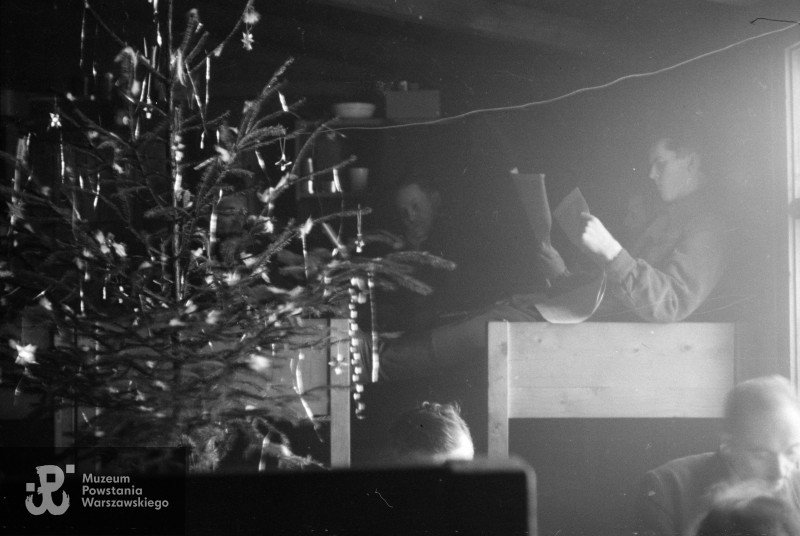
Holiday rest. Jan Gładych 'Bemol' reading a newspaper. Photo by Wiesław Chrzanowski 'Wiesław'/ Warsaw Rising Museum Collection
Liaison Krystyna Friedwald ‘Mewa’ expressed her utter disgust, recounting how in the labor camp near Berlin, the Germans, who broke a strict fast, served meat to the Poles on Christmas Eve (in Poland, traditionally, meat is not served and eaten on Christmas Eve). This questionable gesture of generosity had the opposite effect than intended on the prisoners. Tadeusz Jarosz ’Topacz’, reported that in the camp Voerde bei Wessel, prisoners were exchanging Christmas greetings, splitting bread that had been cut up into small snippets. In the Oberlangen camp the moldy bread was given to the prisoners by the Germans on Christmas Eve and the participants of the Rising shared this bread as if it was a Christmas wafer. Nurse Janina Hajzik ‘Roma’ from the ‘Gustaw Harnaś’ Battalion and the women in the barracks looked in the direction where, in the distance, laid Poland… They were the second group brought to the camp recently on the evening of 22 December. They felt like total strangers there, however, a miracle happened - some other inmates from the camp, who organized some food supplies earlier; came and shared everything they had with the new prisoners. A nurse from the Śródmieście District, Hanna Lawrynowicz ‘Ewa Czerska’ (née Lubecka), spent the Christmas Eve of 1944 in a train that was transporting Warsaw Rising insurgents from Bergen-Belsen camp to Molsdorf. The women shared pieces of bread and onion. They sang carols. During a train stop, they managed to get a twig from a coniferous tree. Although their hair froze to the walls of the carriage, the mood was uplifting and festive.
Christmas Eve in 1944 was one of the most difficult experiences in the lives of the Warsaw Rising insurgents. Those who spent Christmas Eve imprisoned were immersed in the thoughts reverted to their family homes so far away from them. The uncertainty of the future, the sadness, and the longing weighed heavily but the power of Christmas gave them hope not to give up. In the solidarity of strangers sharing their last bread, in words of comfort and friendly handshakes, amongst the singing of carols coated with voices breaking and tears falling, God was being born. Truly.
By Michał Tomasz Wójciuk
Translated from Polish by Klaudia Szymonik